
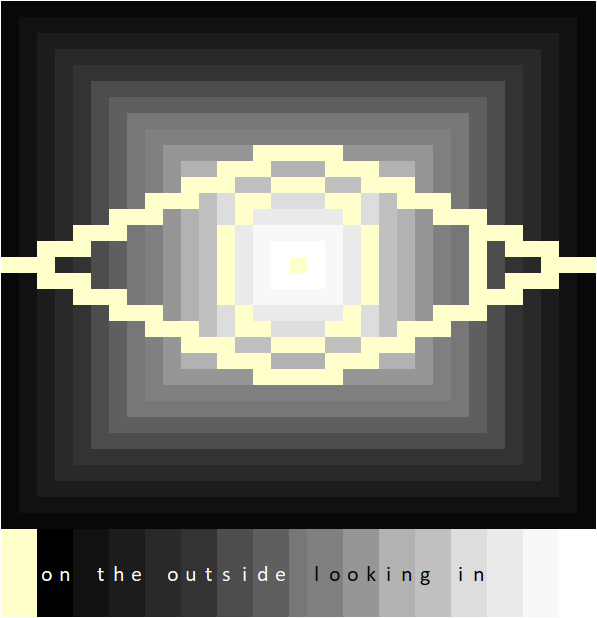
God, he desired it so much, and it was so maddening he could remember it but not now experience it. His mind had difficulty reconciling this fact. To have hope, but to know it is false. He wanted nothing more than to go back.
On the Outside
Looking In
“Jacob,” he heard from the back of his mind, where he had escaped for a short nap.
“Jacob, are you listening?”
He slowly opened his eyes and moved his head up and forward, toward the towering body assuredly approaching him.
“Jacob, did you hear what I said?” Jacob’s teacher echoed his first question.
Jacob opened his mouth to respond, thinking through his answer. He mumbled his words, his lips stumbling into a simple yet clumsy, “Here… I’m here.”
If his teacher knew better, Jacob thought, he would follow his question with, “Are you feeling alright?” Because, all in all, it seemed uncharacteristic for Jacob to sleep in class – to commit the act or even feel the need to. It was an unusual event for any student or any person, much less Jacob; seeming like it might spark concern whether Jacob was alright. But that, too, would be an odd occurrence: to ponder if someone felt less than great, the concept someone could feel less than ideal. And so, it didn’t occur to his teacher, as it wouldn’t occur to anyone, that any human could feel anything other than happiness at any time.
Jacob hadn’t been himself, though. He hadn’t been himself, and he didn’t know what was going on.
He didn’t know who he could talk to. He didn’t know where to start. He didn’t remember how it all started.
Sudden visions, thoughts, feelings, in and out-of-body experiences, each one more intense than the last, longer, more frequent. He couldn’t describe the pleasures he felt – because they weren’t pleasures at all. He didn’t have a word for this, not in his vocabulary at least, and maybe not in the dictionary at most.
He couldn’t remember the first time it happened, but the first time he could remember, it crept quietly, only to abruptly arrive.
He was on his phone. The 5.65 x 2.79 inch feat of technology brought bright lights to his eyes and entertainment to his mind. Entranced as he usually was, and happy as he always was, Jacob scrolled through pictures, sorted through jokes, and read the occasional text, while a state of contentment made its home in his soul, or, more accurately, continued its consistent inhabitance. Jacob had never known any state otherwise. To use the word “always” before “happy” would be redundant; the former inherent within the latter, like the sense inherent within Jacob’s body.
Looking out his bedroom window, a slight flash caught the attention of Jacob’s eyes. He attempted to locate the source of the brief distraction, but his vision could not rein in the sight. He returned his attention to the bliss before him, concentrating on the palette of colors emanating from the glass screen, illuminating his soft face.
As he scrolled through his feed, consuming content to his heart’s content, he found a fifteen second video worth fifteen seconds of his time. Before he could increase the volume on his phone and touch the image of the video to begin playing, he heard a sound he hadn’t heard before. He heard it once, as short as a quarter note, and pressed play. Sixteen seconds later, the video was complete, and he heard the noise again, louder this time, and like a half note. He’d already forgotten the first instance, but there was no forgetting the repetition or mistaking it for the recently finished video.
He looked up, outside his bedroom window. The life outside was beautiful; he knew this, and he always knew this, and because he always knew this he never had to take the time to ever think it: the concrete buildings towering above, the small patches of green below, and the vultures circling around classical, quaint homes surrounding his neighborhood, the fresh gardens at his feet, and the peaceful doves giving rise to flight. And then came the cacophony, again finding its way to his ears, lasting longer than just a measure, more than just a bar.
The sound was sharp, and flat, its dissonance building as much as its decibels. Of course, Jacob didn’t have a word to describe what he was hearing. After all, words with the prefix dis were not commonplace, only slightly less rare than what he was experiencing now. His vision narrowed, auditory hallucinations of whispers grey and black swooping in from side to side. The volume increased, pain surrounding him, inviting him into its arms, enveloping him. He didn’t know what these feelings were; he didn’t like them. “When will the pain subside?” He thought, without having a word to call the pain he was feeling. The colors faded; the dark figures were closing in, offering a tint to his sight.
The first time he remembered feeling this, he thought it would last eternal. Temporary, he learned it only was, but permanent, as he would never forget. Had it happened before, though? And what if it would come again? What if the figures returned, the walls closed in, the noise increased, and the shade recast itself, darkness over the light? What if he once more experienced the antithesis of all he’s ever known? What if it wasn’t just once more?
Early the next morning, still before sunrise, mind racing, his body finally succumbed to sleep. Not easily, not voluntarily. He felt a word no one in his world had ever felt. He’d wake up, and he’d hope he’d never feel it again.
Chapter 2
Jacob responded quickly and confidently, this time attentively.
“Hey Jacob, do you want to come over and sit on the couch and do nothing after class?” Jacob smiled, staring in the direction of Thana, his classmate he’d known his whole life, in the city they called their world and in the world they called their home.
Jacob pleasantly agreed to the idea. He had felt like his usual self all day, and for the weeks preceding, since the last event. His feelings were back to normal: the varying levels of happiness he experienced throughout the day – no matter the degree, always happy.
Jacob followed Thana home, taking the main road through the school district to the neighborhood, the only path necessary to ever take. The two walked alongside white picket fences, small animals playing in the sun, and old oak trees whose familiar presence provided a calming shade.
“So, Jacob, what are your plans for the future? Have you thought about what you want to spend your years doing or who you might be paired with?”
Jacob took in the question. He had an answer, a simple one at that. They all did. They’d choose what their parents were doing, or they’d select the exact opposite, and they’d find the right person – the most right person.
“I think I’ll go into city planning. It’s what my dad does, after he decided not to pursue town destroying, like my grandfather. I mean, it seems like a good job, the City’s already perfect, so what planning would I have to do?”
“And a mate?”
“Ah, I’m not sure. I know the right person is out there, I just have to find them. There’s no person who would leave me unhappy, but if we’re going to settle on a suitor, we might as well find the one who makes us happiest. And who knows who that will or will not be? Maybe they’re here right now.”
Jacob mischievously glanced at Thana, who jokingly rolled her eyes.
“I guess that may be the one thing that isn’t so simple, making sure you find best one, and not passing up on the best one in hopes for a better one all along.”
“Jacob, you think too much. You’ll be happy no matter what.”
Jacob knew she was right. Not only that, maybe she was the right person. He wasn’t sure, and as they turned the corner to her street, he heard a distinct noise. Then, as he tried to think of a playfully clever retort, he caught a glimpse of his shadow, existing underneath the shade of the trees.
He tried to ignore, hoping these newfound issues would be fleeting, but for all of his vain attempts to do so, his effort was futile. By trying to ignore his audible and visual problems, he found himself focusing on them, and they wouldn’t go away.
Jacob told Thana he needed a second, he’d be inside in a minute. She nodded and left him for a moment, and he attempted to regain composure. When he believed he’d succeeded in the task at hand, he realized his ordeal was not over and perhaps was even yet to fully begin.
Jacob crouched over, closing his eyes. All light disappeared from around him, but his shadow remained. It grew in a hue darker than the nighttime tone that now illustrated his surrounding circumference. A screeching orchestra of sounds screamed at him, suffocating his ability to hear his own thoughts. It took his voice, too, almost eliminating his lung’s capacity to breathe.
Thana walked up the drive to the door, turned around, and found Jacob on the ground.
She rushed to him, kneeling to his height.
“Jacob, are you alright?” It sounded like she called out from afar, while their faces were inches apart. Jacob’s eyes opened, hurriedly blinking shut and then back open again, repeatedly, like he was having difficulty comprehending the girl staring at him from eye level and everything going on around him. With each closure, he held hope the next time he would see light, and that when he saw light, everything within his sight would make sense again. Thana reached for his hand, and holding hers in return, Jacob’s tunnel vision arrived at a sudden halt, like a train braking for what might lie ahead.
“What… What, what?” Jacob struggled with the question. He looked around, and although he knew his surroundings were familiar, it seemed like it was his first time seeing them.
“I – I turned back, thinking you were right by my side or maybe a few steps behind, and I saw you on the ground. Are you, are you okay?”
“I, I don’t know, really. I really don’t know what happened. Uh. Um. I need to go.”
“Jacob, but wait, can you move? Can you walk to your house? I’ve never seen that happen to someone. What was that?”
“I have to go.”
“Oh. O-kay.”
“I’ll talk to you in class tomorrow.”
Jacob found himself a couple blocks farther from Thana’s home and a couple blocks closer to his when he fully regained his senses. It was a high to feel normal again. After the unexplainable phenomenon he’d just experienced, any sense of normalcy would feel good. He wanted an eternity of normalcy; before these events, he didn’t expect or even know anything different. He needed to understand what was happening. He rushed to his parent’s house.
Jacob slept.
Wrapped tightly within his warm sheets, a calm washed over him, tiding his anxiety to sea. He didn’t have to worry about worrying if his mind was gently adrift, sleeping. Regardless of the dreams that would meet him at his subconsciousness’ doorstep, he didn’t care – this was currently a better alternative to reality.
Hours later, Jacob awakened to the sound of his father’s voice.
“Jacob, it’s time for dinner. Are you coming down?”
Jacob’s feet began their descent from his bed to the floor and then, atop each step of the stairs, from his bedroom to the first floor.
He was fine. He was no closer to figuring out what caused the previous events, but maybe they were anomalies. Maybe they wouldn’t happen again. Maybe they didn’t even happen. He’d ask Thana tomorrow.
Jacob entered his family’s dining room, where he was greeted by his mother, father, and younger sister. He must have appeared presentable because his dad initiated the conversation with the same lighthearted query he used every night:
“Hey Jacob, how was your day today? A’s and B’s on your tests? 1st or 2nd strings on your teams?”
Avi, Jacob’s father, both genuinely and inquisitively asked the question, proud of his son, even before a response, half knowing what the answer would be, and full well knowing it would be positive.
“School… school was good.”
Jacob didn’t want to be any more forthcoming than required, given what occurred on his way home from school earlier that day – not that his answers were typically expressive to begin with.
“What’d you learn? Anything creative like literature? Anything concrete like math? The architectural history of the City?”
“Well, we started learning about inertia in physics today.”
Jacob looked at the meal on the table and his reflection in his plate. Just the outline of his face, a little darker than the white of the ceramic, prior to filling it with the current diet prescriptions, the flavor of the week.
“Ah, inertia. I remember learning about it when I was your age, before my generation inherited the world. What can you tell about it?”
“So, inertia is an object’s tendency to continue in the same direction at the same speed, unless something causes it to change.”
Jacob heard a hiss in the distance, like someone picked a chord comprised of discord on a detuned string. He couldn’t tell if the noise traveled from behind him, in the upper corner of the room, or if it originated from his mind.
“And to me, when I think of inertia,” Jacob continued, “I think of how it can be applied to things that aren’t objects, things that we experience in our daily lives.”
“Interesting. Do you happen to have an example?”
“Like some businesses, for one. You wonder how they stay in business, when you see their decisions.”
Jacob noticed a black dot ahead of him in the other corner of the room, a breathing silhouette painting itself larger like a ripple in a pond. As suddenly as the blot appeared, when the setting before him – his family and their dining room table and dining room dinner and dining room credenza and chandelier – seemed poised to fall in, it swiftly vanished.
“Or, like,” Jacob watched himself wax expressive, “all businesses, and government, and society and culture, really. There isn’t like one force overseeing it all, and it’s all going full speed, expecting and needing each component to be going full speed. But what if something causes a component to slow or change directions? Does the inertia continue, or does the whole thing break? A lot of moving parts make up an engine, and the tiniest, cheapest, and seemingly least important one can take the whole thing down. Engines shouldn’t be fragile.”
“Hm,” Jacob’s father contemplated the points raised within his son’s notion. Subsequently, he replied, “I think you think too much. But if you do think engines can be built better, we can have you register to be a mechanic instead of a city planner. I wouldn’t be offended… Anyway, did you do anything after class today?”
And within that moment, upon the conclusion of that question, conversation, and Jacob’s own introspection about how he could have just thought those ideas and said those words, the dripping of black color overhead changed from a subtle leak to full submersion, and the scene in front of him collapsed into a pool, his now heaving chest struggling to swallow air and swim.
Jacob was gasping, but his parents paid him no mind. Through violent noises dancing through his, he came to the slow realization he outwardly looked ordinary. Unsure of the cause of these vicious events, or the overall paradox of the situation, still with vision blurred and thoughts racing, he asked to be excused from the dinner table.
Jacob sat on his bed, one leg crossed over the other, both hanging off the side, staring at a picture. He’d calmed down since dinner, but felt anxious about the two intense attacks he’d experienced that day. He felt calm by looking at the picture, but he also felt sadness, despondence, and nostalgia.
Jacob’s family visited the City’s zoo on the day he completed low school. He was 10 years old at the time, and years later, still remembered the day so vividly. His parents and sister watched him walk across the small auditorium stage, hear his name, and receive his paper. After the congratulatory assembly, proud of their son’s achievement, Jacob’s parents took him and his little sister to his favorite restaurant for his favorite dish, and then headed off to the zoo.
That day, he watched monkeys sometimes gracefully but other times clumsily swing from branches, tan and beige tigers wrestle, apathetic alligators swim over one another, and a pride of lions fight over snack time. He went on a tour through the giraffe enclosure, and got to feed one from the vehicle’s window. And he got to name one of the zookeeper’s newest elephants: Albie.
But more memorable than the activities that composed the day, he recalled the emotions that accompanied them: the anticipation of the days leading to it; the excitement of waking that morning; the love he sensed from his family and city; the hope for the unknown certainties of the future; the wonderment he shared observing nature in its element; and most sacred to him, the overwhelming happiness he felt. He was happy every day – it was normal. He was normal. But on this particular day, he remembered being his happiest.
He remembered so thoroughly those feelings, like they were there with him then. They seemed so real, so definable, so attainable, and so joyful. They had just been with him, not very many weeks ago; he had felt them, always and recently. So why did they now seem so far out of reach? Why could he remember what they felt like but not grasp them in his current life? Maybe if he could reach out farther, try harder, or think smarter, he could grab ahold of them again. He would be happy. Everything would be right. He would be happy, and everything would be back to normal again.
He brushed his thumb across the glass shield of the frame. The picture sealed within, a memento to be kept throughout his life, for him to look back on a certain time with fondness. And he realized it was simply that – a specific period of time in his life, he could no longer traverse to, no matter how much he longed to. God, he desired it so much, and it was so maddening he could remember it but not now experience it. His mind had difficulty reconciling this fact. To have hope, but to know it is false. He wanted nothing more than to go back. He was cursing whatever was causing his plight, even though he didn’t know what it was.
He resolved to visit his doctor the next day. That was his hope, but right now, he was helpless.
He got up to place the picture on his bedroom dresser. Prior to setting it down, he stared at it a moment longer, on the outside, looking in.
Chapter 3
“You’re fine, there’s nothing to be worried about,” Dr. Haller stated in Jacob’s general direction, during the 120 second allotment between his 10:38am patient and 10:42am one. “My nurse says you’re seeing a shade or a tint or something or another on daily life, hearing noises like a child learning poorly to play a classical stringed instrument, and not as happy as usual. I would just sleep more, and lay off the intoxicants if you’re on them. You’re not old enough yet to start. But I’m not concerned, and neither should you be.”
And with that, Jacob’s doctor was departing from the room, leaving Jacob with no more answers than he had arrived with.
Jacob reversed his steps out of the room, trying to retrace his steps into the office, in order to successfully navigate the halls to the exit.
As Jacob walked through the corridor, he pondered to himself if his doctor was usually of such little service, if his doctor had ever come across someone with his symptoms, or if someone had ever experienced these symptoms, period.
Perhaps his doctor was right. He didn’t need to worry about it, and he was alright, or at least would be alright. But it’s not like he was imbibing spirits, so perhaps his doctor was wrong?
Jacob finally found the street to begin his journey home. He looked up at the sky; in the season they were presently in, he expected to see grey clouds, potentially rain, and the possibility of a storm on the horizon. Instead, he was greeted by the sun and a light blue background spotted with the occasional soft white cloud.
Nonetheless, still a little chilly, Jacob brought his hands together to his mouth, exhaled, and turned toward his home.
After he took a couple of steps, he heard the sound of someone calling his name from a distance, the voice getting closer, the noise getting louder.
He turned to where he thought the sound was coming from, and noticed the nurse walking up to him.
“Hey Jacob, hey. I’m glad I caught you.”
Jacob peered at her, confused and somewhat startled.
“I wanted to talk to you for a moment.”
Jacob, keeping his confused gaze consistent, wasn’t sure how to respond.
“Your symptoms – what you told me during intake. I think I know someone who can help.”
For the first time during their one-sided conversation, Jacob saw her tan face and kind demeanor. He then peeked at her work scrubs, locating her badge. Nadine.
They were on the sidewalk, next to a fence, across the street from the hospital. Near them, not much foot traffic, or vehicular traffic for that matter, for the time of day. A few cars congregated at the intersection, while a couple people crossed by. By the pair, past the brown, wooden fence, a green, unkempt field some used as a makeshift park for a pleasant afternoon of recreation, and beyond the field, a trail to the natural regions of the City, wilderness untouched and uncharted.
“I’m sorry, what did you say, Nadine?”
“I said your symptoms – what you’re going through. I have someone I can put you in contact with.”
Jacob absorbed the words he had just heard. “Is this real?” He thought to himself, glaring at the bright sun shining in his eyes, like this was a trick the sunlight in cahoots with his mind had in store for him. He had to hope, though, and so he reset his eyes on Nadine.
“Um, yeah. My symptoms. Someone’s experienced them? Someone can help?” Jacob became instantly vested in her response as he asked the questions.
“I shouldn’t really talk any further. Tomorrow, go to the old book bar at the same time as your appointment.”
“Okay, and do what?”
“You’ll see then.”
“Uh, okay? I’ll see you there.”
Nadine didn’t say anything else. She looked Jacob in the eyes, gave a slight smile and acknowledging nod, and turned around to return to the hospital. As she walked away, her long, brown hair bounced over her shoulders, in lockstep with her feet.
Chapter 4
Sunlight was not natural to the establishment Jacob found himself in. The few blurred glass windows did not allow its occupants to identify whether it was day or night. The layout was tight, with stained wood shelves hiding behind faded beams, stretching diagonally to support the structure and perhaps the lives within (if there were any), to keep it from tumbling over itself and returning to the ground from which it came at any given point. Books lined the walls, and dust lined the books, with uppers and downers available at the drink counters.
There were multiple bars and bookstores in the City – plenty of opportunities to fulfill one’s self with enough distractions to maintain happiness. This one, a hybrid of the two, mostly preceded the modern versions in design and atmosphere, its ambiance quieter than the building itself. The brick walls and rustic tables nonetheless preserved a strong historical presence, as if this place was once loud with the voices of many visitors, and the air was stiff, like it was the same air lingering from those older days.
The browsing area – not differentiated from the seating arrangements – smelled stale, like the distinct mustiness that accumulates in a room that has not been occupied since its own era. The scent, and the overall appearance of the book bar, was off-putting, yet it oddly gave Jacob a sense of comfort, at least in comparison to the anxiousness he was trying to control, putting his current mood in conflict with itself.
Jacob sat in the back, so that he could get a full view of the front, and the people venturing in through the single wooden door entrance. Seldom, though, did people enter, and for the seven minutes Jacob had been waiting – now two minutes past 10:40 – only a couple other patrons had been observed. Still, Jacob had to be ready, he told himself: “I have to be ready.”
Jacob wasn’t sure what to expect, but he was nervous, and hoping his nerves wouldn’t usher in another painful bout. He was anticipating the metal doorknob to creep counterclockwise and the door to creek open, with a single, potentially stoic individual to walk in and offer him the help he so desperately desired. That, or for law enforcement or a specialty physician to apprehend him and then escort him to an undisclosed location, leaving him to never be seen again. He knew the City plans though, and he didn’t recall the existence of such a place.
Jacob was giving up. The mere minutes past the agreed-upon meeting time stretched into hours, at least as perceived by his apprehensive impatience. Like the candle in the dimly lit part of the bar behind him, his hope rose quickly, flickered unsteadily, and was ready to extinguish at the slightest breeze to pass by. Just when Jacob was making preparations to leave, the door opened.
It was an older gentleman who entered, and who made his way to the counter, without paying any attention to anyone around him. Jacob studied him, blind of his own surroundings. “This can’t be the person I’m here to meet,” Jacob whispered to himself, dejected.
“No, he’s not,” a woman’s voice responded from Jacob’s immediate vicinity. He then noticed the candle was no longer burning, there was a door behind him in the very back of the bar, and there was now a woman with long, brown hair standing next to him.
“May I sit here?” The woman asked Jacob confidently, not waiting for an answer.
Jacob inhaled a deep breath while he took in the situation. The meeting was happening, he wasn’t being tricked, and maybe he’d get the assistance he needed.
He looked up from the small table to the woman. Sitting across from her, he recognized her tan face.
“Nadine?”
The woman and Jacob locked eyes; he noticed she didn’t have the same smile as the nurse from the day before.
“Nadine is my sister. My name’s Marie.”
Jacob stared, confused momentarily, prior to processing the information readily.
“My sister called me yesterday,” Marie continued, “about you.”
Marie paused – Jacob assumed it was to gather her thoughts, but she seemed poised and her presence planned, like she had already chosen her words, and she had done so carefully.
“She told me of the issue you’re facing, how you’re not feeling yourself, how you’re not happy.”
Jacob broke their eye contact and looked back down, almost ashamed, and somewhat grateful no one was around to hear the truthful accusation.
“I understand it must be difficult to not be happy when it’s all you’ve ever known, and it’s all everyone around you has ever felt, and all everyone in society has ever seen. I understand because you’re not alone.”
Shocked, Jacob’s vision, previously shunned from the situation, hurriedly reverted to Marie. Serious in tone, she kept speaking:
“Other people in our City have felt like you feel now. Other people in our City still feel like you do now. I, personally, know what it is like. You are not alone. You’re not the first, and you will not be the last.”
“So, what can we do about it then?” Jacob blurted. “What can I do about it?”
“Nothing,” Marie replied. This was no time to be rhetorical, and she never considered it. Only a dry, honest, truthful, and cold response would suffice.
“What do you mean nothing? If other people have felt like, do feel like this, why can’t we do anything to fix it? Have we tried anything? You feel like this!”
Jacob grew agitated, as a result of his emotions ranging from anxious to despondent to on the verge of answers to nothing within a matter of minutes.
“There is nothing you can do because that’s how it is. That’s how we live our lives. There are not many of us. Not any, really, as far as the world is concerned. We have tried, and there is no cure. You cannot be always happy again. But you can learn to live with it.”
Calmer than he was seconds earlier, Jacob composed himself enough to state, in a monotone manner, “So there’s a treatment…” Almost as if he was saying it to himself.
“Yes, there is. That is why I am here. I will help teach you to live with it. There are times you will be happy again. You will not always be sad. But you must understand that your old way of life is no more.
“You have to accept that fact, and only then can you begin to live.”
“And what if I choose not to?”
“Then that is your decision,” Marie answered Jacob without expectation. “It does not make sense to do so, and therefore it is not an option I would select.”
“What will happen if I don’t? Can’t I still try on my own to figure it out, to get better, to return to how life once was for me and is for the majority of the City?”
“You will not succeed, trust me.” Marie regretted the use of those two words, for she was not seeking his compliance. “I do not mean to be rude, but I will remind you of the few of us who have been where you’ve been: some have tried as you suggest, and they have failed, and the rest have accepted it and moved on, which is my recommendation. Now, what is your decision?”
“What happens if I don’t accept it?”
“Then come with me. I will show you.”
The air was tight, the temperature lower than usual, and a breeze passed between them now that they were outside the confines of the City. Grey clouds hung slightly overhead, and a steep drop could be seen below.
Jacob knew this place, although he didn’t. They were at the natural regions of the City. The natural regions were included in the City’s geographical map, but no one ever traveled here, and the details of its landscape were scarce.
Jacob and Marie were on a mountain ridge that appeared with little warning once they arrived at the end of the dirt trail and made their way through a short strip of densely populated trees and bushes. About 40 feet separated the last vegetative barrier from the edge of the cliff, Jacob and Marie now standing between the two.
Jacob looked into the distance, wondering how expansive the world really was, not able to truly grasp whether it continued or stopped, his vision blocked by the slow-moving fog. The grass was half dead, half alive – no artificial traffic to interfere with its growth, but nature’s cooler weather and lack of consistent sun working against it, given the time of year.
“I know where we are,” Jacob broke the silence. “We’re in the natural regions, the wilderness no one ever visits. It’s beyond the outskirts of the City. I know exactly where this is.”
“Everyone knows where this is. Not everyone knows what is here.”
“No, I’m familiar with it. It’s uncharted territory.”
“Exactly. You are familiar with the knowledge it exists. You are not familiar with what it is you see.”
Jacob was perplexed by the notion, and although Marie’s conviction assured him of her wisdom when she spoke, he was tiring of hearing her voice.
“What are we doing here?”
“You said you wanted to know what happens if you don’t accept the situation for what it is. I am showing you.”
Jacob halted the additional questions that wanted to depart from his mouth. Any questions he asked would be met with condescension and contempt, he figured, yet he also somehow understood she wasn’t exhibiting either. He crawled to the conclusion that her serious tone, short answers, and lack of emotion were all because of the gravity of the situation. But how could this predicament be more significant than it already was?
Marie looked upon Jacob with a demeanor that conveyed she knew what Jacob was thinking at that exact moment and felt what he was going through, and for half a second seemed compassionate before returning to constraint.
“So, show me,” Jacob acquiesced, resigning himself to what Marie would do next.
At Jacob’s request, Marie inhaled, exhaled, and then said, “Jump.”
“Excuse me?” Jacob retorted, defiantly.
“I said, ‘Jump.’”
“What do you mean, ‘Jump?’ How can you say something like that? Tell me to jump? What is wrong with you?”
Marie was silent, but kept her eyes locked on Jacob, who was now becoming angrier by the breath.
“What kind of choice is that anyway, to jump?” Jacob shouted. “What sort of option is death?” He screamed. “That’s not an option! That’s an ending!”
Jacob was winded with rage, his chest moving in and out quickly, breathing heavily. The act, combined with his yelling, calmed him to a minor extent, enough to focus and see Marie dawn a small smile. It was at this time it then dawned upon him, the truth, the message, the lesson:
“There is only one choice. There is only one option. I have to accept that life will not be the same again, I will not always be happy, like I once was, and like everyone in the City still is. I have to accept this and learn to live with it. I have to move forward because to decide otherwise does not make sense.”
Marie nodded at Jacob in agreement, and they began their journey back to the City.
Chapter 5
“It comes and goes, you know,” Marie remarked to Jacob with a hint more of emotion than she’d shown the week before in the bar and on the mountain.
They were sitting in one of the City’s parks, the closest one to the ocean. It was a cheerful day, and Jacob felt optimistic for the future, having accepted his past, ready to see what fate might bring him, and what he might bring it.
“You’ll feel good one day and then bad the next. Happy one hour, then sad the next. Sometimes it’ll last for days or even weeks, maybe months, and then, just as quickly as it came, suddenly it’s gone. Both moods – phases, really. You’ll learn to recognize when they’re coming and realize when they’re going.”
Marie had been talking for some time now. Jacob lost track of how long, but he didn’t mind.
“When you’re feeling normal, you see everything clearly, with 20/20 vision, and everything sounds pitch perfect, too. But when you’re not as lucky, the clouds roll in, the day has a grey tint to it, and the melody is off key. When this happens, if you understand it’s happening, you can look at it with a different lens, know how it’s affecting you, and remember that you are still yourself, and soon you will return to that person. This is just a different, temporary self and a temporary state you have to share with yourself – with your happy self.
“And I won’t lie, talking is much easier than living. Even now, I can say these words to you, knowing that when I’m in the throes of it, I might be much different, and these words might be much more difficult to live by. I’ll forget them or believe they aren’t true and go back on the progress made. For each step forward, there will be one to the side, a half a step backward, or one to the other side. I will hear the grating noises, disturbed voices, and see the dark colors. My sight will be dimmed. The exterior I put up will cave in, and I will feel like quitting, occasionally like quitting it all. One step forward, stumble to the side, and fall.
“But I will get up, and in my stride, I will strive to be better. There are two options, and one I’ve already chosen. I will be defiant in defeat and keep going, getting up, and striving to be better. I will try for my own sake, quite literally, and keep going. Over time, I’ll learn to live with it, overcome it, and know that there is no perfect, but at least I’m close to it. At least I can define what “perfect” is for me. For many more days will I see a wide array of beautiful colors than not. Many more days will I hear music play the most in-tune harmonies and breath-taking melodies than not. With life as my symphony, witnessing nature as my scenery, I will feel happy, and I will be content with myself. Who I am will be enough, and in these times, everything will be alright.
“Remember, the other option is to not live, and to die, it makes no sense. Alas, it’s a solution, and a right to which each person is entitled, but to do so for myself, I do not give myself permission. It’s a route I will not walk. I would get lost, not know when to turn around, and never find my way or myself again – I would never have the chance to try, and I’d never wake to wonder what a new day has in store for me or I for it again.”
Marie breathed in a deep breath and let it out, relief. She’d said many words, put her many thoughts into one statement, for Jacob’s ears but also her own. She’d been lost for a moment but found herself, and asked internally whether Jacob was lost, too.
“It will get better. It will get better for you if you keep moving. The world won’t seem so wrong. You won’t feel so alone. Just keep moving, and trying, and taking another step forward, and making it another day, and you’ll be okay.”
Marie steadied her head, providing a reassuring look – but again, it was just as much for Jacob as it was for herself.
“You don’t have to trust me, and I’m not here to promise you. It works for me, and right now I can say I’m fine, and even during my bad times, I know I’ll still be fine.”
Without words but a mutual, unspoken agreement about the conversation’s conclusion, the two sat in silence, listening to the ocean’s water come and go with the tide, watching the waves break over themselves, reforming each time.
Jacob was out with friends on a normal Friday night. They had started the evening by congregating at a friend’s apartment, moving to one venue and then a second. It was like how things used to be.
A month earlier, he could not have dreamed this reality was even a possibility.
They were at City Midtown, a tap house located directly between the historic City downtown district and modern City uptown neighborhood. Sober but potent drinks of any flavor and every style were served at Midtown, and all attendees could find themselves in the picture-perfect setting the bar’s background elicited.
The place was lively, the building forming an external personality of its own, influenced by its inhabitants. Libation in hand, Jacob was laughing at his friends’ jokes, surrounded by strangers, and telling tales of his own.
“Remember when we spent the whole entire day outside walking, running, and hiking, and couldn’t get service any longer? We weren’t in the wilderness, but we just lost service, somehow, for some reason. And then we were lost and couldn’t find our way home for most of the day. Our parents were so mad, and even though we were tired, I couldn’t stop laughing. It seemed so silly to be mad about being lost in our City.”
It was a story he’d repeated many times, but it remained great each time it was recited. They would be satisfied hearing it many more times. Jacob was gratified, fulfilled, and happy. There was nothing more he could want.
“At least we know where everything is now and have been everywhere worth going. Man, I never want to go that long without service again.”
It felt almost dreamlike to be here again, to be happy again, with an evening running so smoothly. Jacob looked around at the crowd surrounding him, lights strewn overhead, music flowing from all four corners, cares checked with coats. He wasn’t overtaken with the urge to leave but instead desired to stay and hoped the night would continue this way.
Jacob stepped away from his group momentarily, not to exit but to refill his drink. On his trip to the taps he noticed the number of individuals in the restaurant, and he wondered if any had ever experienced what he’d gone through, or if any were currently going through it now. Marie had told him he wasn’t the first or the last to be unhappy.
“Marie – she’s the reason I’m here right now. I need to tell her tomorrow,” he thought to himself.
He gazed at the pack again, observing it before returning to it. He was excited to see how the night would play out, knowing he’d be happy no matter the outcome.
“Why did you want to see me today?” Marie asked Jacob, short and to the point. They’d met a couple of times in the month preceding, since their original introduction, but they weren’t conversing on a regular basis, and Marie wanted to avoid it appearing like her personal reflections were instructions.
“Thanks – just, uh, I just wanted to say thank you. If it weren’t for you, I don’t know if –”
“Stop,” Marie interjected. “I get it, I understand, but please don’t carry on further.”
Jacob figured to keep his words to himself, but then offered a different direction for the discussion.
“What do you call it by the way? You know, whatever it is I experienced, that we feel?”
“You really want to know?”
“Yeah. Do you have a word for it?”
“Well, it’s not scientific, but there’s ancient planet mythology, few have read. There’s a story about a man who indulged in everything and didn’t care about anything, and when the other townspeople in the civilization saw how happy he was, his attitude, behavior, and character began to influence them. The town proceeded into chaos. No neighbor looked after the other. No individual was selfless for the group. Notwithstanding, they had a surplus of food, so there was no famine. They had an excess of homes, so there was no hardship. The main concern was simply how they could eat better, drink finer, build higher, get richer, and indulge in more. Aesthetically, the town was more pleasing to the eye than their forefather’s. But inside the interior of each house and skin, the town was ruined. The persons and personalities, once bright, turned to darkness. The colors of their clothes could not mask their sins in the eye of the God De, and he cursed their words and their lives with those two letters: decimate, decease, decrease, defeat, despair, decline, defile, debase, degrade. De expected and exulted the destruction his curse would bring, causing some of the townspeople to become hungry and homeless, but De incorrectly predicted that the lucky would care about the unlucky and work to make them whole, and so the hungry and homeless remained. The lesson was never learned and therefore the curse was never lifted, and the ‘De’s exist to this day.
“I call what you experienced, what we feel, ‘Depression.’”
Marie stared straight ahead, eyes wide open, like she was concentrating on something but in complete honesty was focusing on nothing, finding herself enwrapped in the myth, absorbed by the belief.
“It’s like a virus. It affects us. Some of us, not all of us. Only select ones.”
With no words left to say, she regained her normal stoic stature.
“Hm, depression,” Jacob pontificated. “I think it’s a good name.” Jacob paused prior to finishing his thought:
“It’s a shame it’s not defined in the City’s dictionary.”
Chapter 6
Jacob wore a button-up shirt with the collar locked down and the sleeves open, coupled with his best jeans, followed by clean boots. He was sitting in a dark brown and beige chair at a faux-wood table, inside a vibrant restaurant, accompanied by a date. The doors and windows were set to allow cool air to flow through the busy, trendy spot, and Jacob stared over the table at the sleek, brunette hair and kind, blue eyes sitting across from him. It was months since Jacob’s last major incident.
He had experienced minor ones in the time since, but he took them as they came.
His daily life had returned to normal. He was usually happy, and capable of completing all of the daily activities one’s life consisted of in the City: school, work, friends, parents, being busy, being trendy, and being happy. To be close enough to his old self was good enough, in that he almost couldn’t tell the difference. He was perfectly happy, so much so that it felt as if he was in a dream-like state for life to be going so well. He figured it wouldn’t go well forever, but he would vow to enjoy it while it did. He studied the restaurant, and he noticed the considerable number of people within.
What if they were going through what he went through before and might go through again, and they were silent in their plight?
Jacob was enjoying his date; it, too, was going well. The conversation was easy and enticing, and there were two drinks at their table, and two plates full of food. And to the left, right, straight ahead, and behind, another two, three, four, and five. Becoming increasingly aware of all of the people around them, Jacob instinctively asked himself: What if they were experiencing it? What if they weren’t happy? What if they were depressed? And they just weren’t discussing it, letting it be known, because it wasn’t normal, and because no one else felt it or knew what it was like. Maybe everyone was like this, Jacob contemplated. The thought consumed him. Maybe the dark figures and sharp noises surrounded everyone else like the crowd surrounded him now.
The idea took hold of him, and as much as he wanted to continue conversation with the inviting lips speaking in front of him, he couldn’t stop thinking about and struggling with the concept of many others, perhaps the majority of people, being unhappy. He had to talk to Marie. He had to know more, to find out the truth – if she knew – and how prevalent it is.
“I have to go.”
“Go where?”
“I don’t know yet. But I’ll figure it out.”
Jacob found Marie where they first met – at the book bar, where he first learned what he was experiencing, and where she first said he wasn’t the only person to experience it. He figured she frequented it often. It was secluded and reserved, like her.
“When you told me I wasn’t the only person, wasn’t the first, wasn’t the last, what did you mean by that? How many other people are like me?”
“No one else is like you except you.”
“You know what I meant. How many other people are depressed?”
“I don’t know. It is hard to say. I know of the ones I have counseled. I have heard of others. But some keep it to themselves. And others go to the mountain.”
“How many is that? Do you have a number? A percentage? Anything?”
“Perhaps 10% – if I had to say. But again, it is hard to know, and I do not dwell on it.”
“You said death doesn’t make sense, but this doesn’t make sense either. If 10% of our City is depressed, why don’t we talk about it? Why don’t we do anything about it?”
“We do what we can. We do enough.”
“But we’re not doing anything, that’s the point. If people are living like this in silence, how are we doing anything? We’re not doing what we can, and we’re not doing enough. People like us are struggling, and we’re doing nothing to help them. Doesn’t that bother you?”
“I do not understand where you are coming from here. Are things not going well for you? Has your life not improved since we first talked?” Marie was becoming exasperated with Jacob’s line of questioning: he was once again normal or close enough to it, he knew how to handle his unhappiness and manage his depression when it visited him, and so did most others who were greeted by it, so why did it matter if it wasn’t acknowledged and help wasn’t outwardly and openly available?
“Yes, it has, and I thank you for that. But just because I’m feeling better doesn’t mean everyone else is. I shouldn’t stop with myself. We shouldn’t stop with the people who you’ve helped, who you’ve probably also told aren’t alone and who you’ve potentially also told not to make their voices heard. We should do what is in our power to make sure everyone around us is fine, and to not be so comfortable with this notion that talking about it is wrong or weak, irrational or illogical, unnecessary or some other condescending conception that misses the point entirely.”
“I don’t like the tone you’re speaking with.” Marie was growing further agitated, while Jacob continued his impassioned plea, incensed at the situation, fighting forth in disbelief that he was even having to argue his point, that this was even a debate, that this was even a conversation.
“Stop being so assertive in a belief that is grounded in fantasy instead of rooted in reality. If we’re not all doing alright, we have to do more, and it starts with talking about it and allowing it to be acceptable to seek help. We can’t let people fight themselves in their heads, in the dark, in their minds, with the corners closing in and ceiling caving down and whispers of insecurities acting as their only companion. They’re suffering, and somehow it’s tolerable we do nothing. I guess we can just ignore it if it’s not us? I can pretend it’s not there unless I experience it again, and until I do, I can forget about it and forget about my friends and even strangers who can’t because they’re in the middle of it at this very moment? At the very least we can talk about it, make it be known, out in the open, let people’s voices be heard, let them know they’re not alone.”
“No, that wouldn’t make sense to do. The people who are affected have accepted their lot in life. To talk about unhappiness would be to let the City’s population know that not everyone is always happy and that one can, in fact, be unhappy. It would taint the City and its people’s happiness, their lives. We cannot take that from them – we should not. That is our duty, our responsibility, our obligation and burden to bear. We live with it so that others do not have to. And for all we know, talking about it, letting it be known, could increase the number of people who catch it.”
“Or we could decrease the number of people with it.”
“If a person cannot come to grips with their fate, then they can go to the mountain.”
“That’s bullshit. We shouldn’t leave people with two options, where one is we don’t help them and the other is they die.”
“You can go to the mountain, too, if you don’t like it.” Marie let herself become emotional because of what felt like an interrogation aimed at challenging her truths; she didn’t mean what she had said. She tried to lighten its impact:
“I have thought about going to the mountain, and still do from time to time. It never fully goes away, that curiosity. You continuously have to fight it. Sometimes it isn’t there. Sometimes you have to try your hardest to make it go away.”
Jacob tried to gather his thoughts, hoping to speak smoothly, but sternly replied, “You know, I’m starting to think this is all bullshit. This must be some City conspiracy. Specific people are being chosen to suffer. But why? Is it because we weren’t going to fall in line? I was in line, was I going to fall out sometime? Is this our punishment? Or is this the way to make me, to make the certain people selected to be different, comply?”
“No, what do you think this is, a shitty dystopian novel? This isn’t a conspiracy. This is real life.”
“Well, it might not be fiction, but I’m starting to think it’s a dream.”
“And you’re the one who accused me of bullshit.”
“You’re right. I did.” Jacob again tried to be patient in his response, this time proving more successful in his endeavor: “I’m going to the mountain. But unlike you said, I have come to grips with my fate.”
Jacob found himself at the end of a dirt trail, overlooking the edge of a cliff. He couldn’t quantify the height of the mountain or the drop below, but he could qualify the result.
He had become ever-convinced of the idea that he was trapped in a dream, stuck in a layer of his mind outside the layer of consciousness. And even if he wasn’t, he decided the end would be a better alternative to the existence he was experiencing. He didn’t wish to live with an outcome in which one person did not bother to help another. He was finally happy with his self, but personal happiness meant nothing if others were suffering.
Jacob took a couple of steps closer to the end of the mountain, the unobstructed wind from the elevated altitude beating against his body and chilly temperature cooling the blood in his veins and calming the pulse in his nerves. He was committed to his decision, not blind to different choices, as there were none, and not deaf to dissenting voices, as he heard none. There were few options: two, to be exact – and at this point, only the one made sense.
It would not be an end; it would be a beginning, a return to real life and his true self. He would awake from the dream, and at worst, if he was wrong, then it would be the end, and he would be unaware he was wrong. But he was sure he was right. This was all a dream. In the real world, everyone was happy. In true existence, everyone cared whether their fellow friend was happy. He was sure he was right. This was a dream.
Jacob took a couple sure steps before suddenly becoming uneasy, with doubt in his decision creeping in. He remained resolute in his conviction, though, and quickly regained traction in his footing. Two footsteps, then a few, and he was looking over the ledge at the drop below.
He inhaled the cool air that inhabited the mountaintop. He was at its home, and he was soon to return to his own. He lifted one leg to hold his right foot out over the abyss, thinking about the world, the dream he’d leave behind. He’d be happy, he told himself. If only he could get back to the picture on his dresser, to the day his family spent together at the zoo, to a period of time in his life when he didn’t just remember how it felt to be secure in his place in the world but actually experienced the feeling.
He leaned over the edge of the mountain. The weight of his chest hung forward, creating enough momentum for his body to work in tandem with gravity, and his left foot lost touch of the surface below.
For the first 40 feet, he was relieved. And another second later, still at peace. But as the seconds lasted longer, his sense of fear grew greater. What if he was wrong? What if this was real? What if he wouldn’t wake?
“I should have jerked awake by now, like I’ve done many times before during a dream in which I’m falling. I should have jerked awake by now. What if this was a mistake? I should have been awake. I just want to be awake.”
Jacob continued his path down toward the ground; the fall was a journey surviving for an eternity – Jacob wondered how much longer until it was over, hoping he would remain in the air long enough to conceive a solution.
“I pray to wake or go back on this mistake. I would wait for things to get better again. I know they’d get better again. And I’d do what’s in my power to make them better again for myself and my neighbors, both strangers and my friends. Not like this, I don’t want it to end. But this was my decision, the option I had chosen, hoping just to begin. A new day in my old life since my new one wasn’t right, but my old life isn’t coming back, and it’ll all be over in seconds when my vision goes to white. It’ll all be over in seconds. I wish I’d never taken flight.”
The cool air disappeared. There was no rush of wind. The sensation of falling faded – there was no sensation at all. Everything was white.
Chapter 7
Jacob awoke to a beep – multiple ones in a row, in a pitch high enough to wake him from his sleep.
He looked up at the ceiling above. It wasn’t caving down. He stared at the corners of his room. They weren’t closing in.
He felt an overwhelming sense of happiness as joy washed over him. He had returned home to the normal, perfect life he was in when he went to bed the night before, before he fell victim to a vivid, bad dream. He smiled, relieved to be home, grateful for the world he lived in, and confident everything would be right and nothing could go wrong again.
He rolled over to pick up his phone from his nightstand. He grabbed his connection to the outside world and checked his notifications.
One friend texted that two of his brothers got into a fight overnight, leaving one incarcerated and the other incapacitated.
One online post stated a shortage in both water and food was expected for the fall, leading to a ration based on means for those with and not without.
One news headline read there was a plague spreading throughout the City, causing illness in whoever came in contact with it.
The engine broke. Inertia stopped.
De made his presence known, to bring destruction and despair.
Things were not back to normal. Nothing was the same, and it would never be once more. Jacob felt an overwhelming sense of dread, experiencing depression – the brilliant colors vanishing from view – knowing that everything was wrong – the sharp noises rising in volume – and holding out no hope for anything to be right again.
He had awakened to a nightmare, except this time
Everyone was with him
On the outside
Looking in
*************************
Author’s Note:
Thank you for making it this far, both literally and figuratively.
I wrote this piece with depression as the driving theme, similar to many of my writings. However, while I was writing the story, it became apparent to me that there were other factors I had to consider, largely due to the events occurring during the time the story was written. When I look at those events, the little issues in my life seem so small. By little issues, I mean when I get upset in traffic, if I become bored of how 99% of life seems like it’s half work and half us talking about our favorite podcasts at our favorite brunch spots, and that a shirt I impulsively bought because it was supposed to complete me didn’t fit me and therefore couldn’t complete me. There are so many more important and actually worthy issues to be worried about, concerned with, that I needed to account for when I wrote this. I wish everyone in the City world tried to empathize more. I want everyone to care about their neighbors, brothers and sisters, whether strangers or friends, more. We are all people, and we should all be cared about. We are all worthy of love, and we are all worthy of a life that provides us with enough to at least try to be happy, even when our brains aren’t as cooperative. I hope everyone can come together to make the unlucky lucky and the have-nots lose the not. I know the majority of us do what we can – but it’d be so much nicer to be able to say more than just the majority, or to not even have to make this statement at all. But then again, what would I have to write about it if I didn’t have to write about this?
However, the big issues remain, no matter what events are currently ongoing. Depression is a serious thing, and more of us should talk about it, destigmatize it, and treat it. We’ve come a long way from where we used to be, but we still have a long way to go.
Let’s continue the dialogue and progress so that one day our children’s lives will be better than our own.
We are all humans.
Let’s let history remember the good traits of our humanity.
 WRITE | POST | CREATE